If you’ve been trying to keep up with AI tools lately, you already know how fast things move. But when it comes to visuals, the leap has been genuinely staggering. The best AI image generators 2026 has rolled out can now produce photorealistic scenes, cinematic artwork, and brand-quality graphics from a single line of text — in seconds. Whether you’re a solo content creator, a marketing team, or just someone with a creative idea and no design background, these tools have changed the game completely.
This guide is your no-fluff breakdown. We’ll walk through which of the best AI image generators 2026 offers are actually worth your time, which ones are free, and how to choose the right one based on what you’re trying to create. By the end, you’ll know exactly where to start.
How the Best AI Image Generators 2026 Have Changed the Game
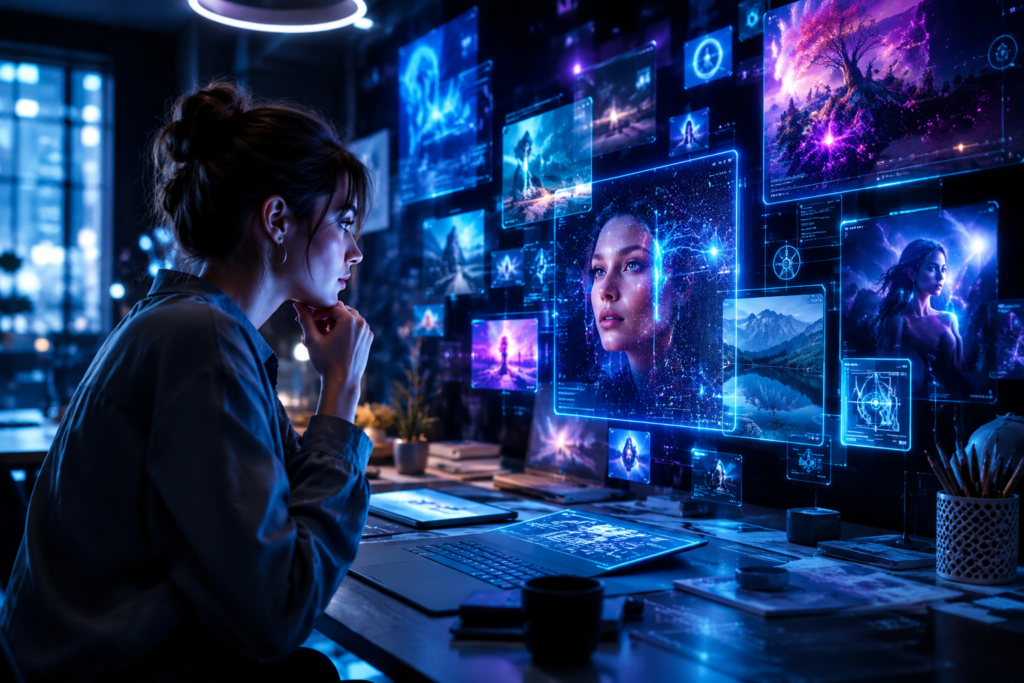
Not long ago, AI-generated images had a very obvious tell — strange hands, blurry text, faces that looked almost right but not quite. The best AI image generators 2026 has introduced have largely solved those problems. Output quality has improved so dramatically that even professionals are having trouble spotting the difference between AI-generated and human-crafted work.
What’s driven this shift? Mostly better training data, smarter architectures, and feedback loops built around real creative use cases. The best AI image generators 2026 brings to the table are no longer just “prompt and pray” tools — they understand context, lighting, composition, and stylistic intent in ways that feel almost intuitive.
Beyond raw quality, the ecosystem has matured. The best AI image generators 2026 makes available aren’t just generation tools anymore — they include in-painting, out-painting, style transfer, upscaling, and real-time editing. The full creative workflow is increasingly handled inside a single platform, which is a big deal for anyone who used to juggle five different tools to finish one piece of visual content.
Which AI Is Best for Image Generation in 2026?
This is the question everyone types into Google at some point. And the honest answer is: it depends on your use case. But if you want a shortlist of the best AI image generators 2026 has produced, these three consistently come out on top.
GPT Image 2 by OpenAI
OpenAI’s GPT Image 2 is one of the best AI image generators 2026 has seen from a major tech company. After DALL·E 3 started feeling a bit behind the curve, OpenAI came back strong. GPT Image 2 uses a conversational prompting model — you describe what you want in plain language, and it delivers with impressive accuracy. It’s particularly strong at following complex, multi-part instructions and producing coherent, detailed scenes.
The trade-off is speed. It uses an autoregressive model rather than diffusion, which makes it slightly slower than competitors. It also generates one image per request rather than a batch. For quality-first workflows, though, that’s rarely a dealbreaker.
Midjourney V7
Ask any professional designer or concept artist which of the best AI image generators 2026 offers they reach for when aesthetics matter most, and Midjourney comes up again and again. Version 7 pushed the quality ceiling even higher — sharper detail, better coherence across complex compositions, and that signature cinematic quality that made Midjourney famous in the first place.
The downside is the workflow. It still runs primarily through Discord, which can feel clunky if you’re used to web-based interfaces. And the pricing isn’t particularly generous for casual users. But for pure visual quality, nothing touches it.
Adobe Firefly 3
Firefly has quietly become one of the most practical entries among the best AI image generators 2026 has on offer — especially for anyone already living inside the Adobe ecosystem. It’s woven directly into Photoshop and Illustrator, which means generation, editing, and refinement all happen in the same workspace. It’s also one of the few tools explicitly designed for commercial use, with images that are licensed and safe for business applications straight out of the box.
Which Is the Best AI Image Generator Right Now for Everyday Use?
Not everyone needs a professional-grade creative suite. Sometimes you just need something fast, accessible, and good enough to get the job done. Here’s where the best AI image generators 2026 brings to everyday users really shines.
Google Imagen via Gemini
Google’s Imagen model, integrated directly into Gemini, has become one of the most accessible of the best AI image generators 2026 offers to general users. The free tier is genuinely usable — not just a teaser — and the output quality holds up well against paid competitors. If you want powerful AI image generation without setting up an account on yet another platform, Gemini is the smoothest entry point available right now.
Leonardo AI
Leonardo AI sits in an interesting middle ground. It’s one of the best AI image generators 2026 has produced for creative professionals who want more control than consumer tools offer, but less friction than running Stable Diffusion locally. It has a library of specialized models, supports fine-tuning, and produces particularly strong results for character design, game art, and fantasy environments.
Stable Diffusion (Local / Open Source)
For developers, tinkerers, and anyone who wants total creative freedom, Stable Diffusion remains unmatched. It’s open source, runs on your own hardware, and can be extended with thousands of community-built models and plugins. The learning curve is real, but the ceiling is essentially unlimited. Among the best AI image generators 2026 has made available, this is the one with no guardrails — and for the right user, that’s exactly the point.
Is There a 100% Free AI Image Generator Worth Using?
Yes — and this is one area where the best AI image generators 2026 has genuinely surprised people. Free doesn’t mean bad anymore.
Microsoft Designer
Microsoft Designer is powered by DALL·E and is completely free for basic use. It’s baked into Bing Image Creator and the broader Microsoft 365 suite, meaning millions of people already have access without realising it. The interface is clean, the results are solid, and there’s no subscription wall for everyday generation.
Google Gemini Free Tier
As one of the best AI image generators 2026 has made available at no cost, Gemini’s free tier is hard to beat. You get a daily allowance of image generations, and the quality is legitimately impressive — not “impressive for free,” just impressive. Paid plans unlock higher limits and resolution, but the free version is a real tool, not just a demo.
Canva AI
Canva’s built-in AI image generator is another standout among the best AI image generators 2026 provides for free. It’s particularly useful because it’s integrated into a full design platform — so you can generate an image and immediately drop it into a social media post, presentation, or banner without switching apps. For content creators and small businesses, that workflow efficiency is a genuine advantage.
Adobe Firefly Free Credits
Adobe gives every new user a batch of free generative credits. It’s enough to test whether Firefly fits your workflow before committing to a subscription. Once those credits are gone you’ll need a paid plan, but it’s a fair way to evaluate one of the best AI image generators 2026 has on offer for professional use.
What to Look for When Comparing AI Image Generators
With so many tools out there, it’s easy to get overwhelmed. Here’s the framework that actually matters when you’re evaluating the best AI image generators 2026 brings to the market.
Prompt adherence — Does the output match what you described? This varies enormously between tools. Some follow instructions literally; others interpret creatively. Neither is wrong, but knowing which you’re working with matters.
Output resolution — For social media, 1024×1024 is usually fine. For print or large-format work, you’ll want tools that support higher native resolution or include a quality upscaler.
Generation speed — Most tools are fast, but when you’re iterating through dozens of variations, even a few extra seconds per image adds up. Speed matters more than most people admit.
Editing tools — The best AI image generators 2026 makes available go beyond just generating. In-painting, out-painting, and selective edits are now table stakes for any serious tool. If a platform doesn’t offer these, it’s already a step behind.
Licensing and commercial rights — If your output is going anywhere near a client, a product, or a paid campaign, check the terms. Not every tool grants commercial rights by default. Adobe Firefly and a few others are explicitly built for this use case; others have murky terms that could cause problems later.
Pricing model — Free tiers, credit systems, and monthly subscriptions all work differently. Know what you’re signing up for before you get locked into a workflow around a tool that turns expensive at scale.
Best AI Image Generators 2026: Matched to Your Use Case
Picking the right tool isn’t just about which is “best” overall — it’s about which is best for you. Here’s how the best AI image generators 2026 has produced stack up across common creative scenarios.
Social media and content creation — Canva AI, Microsoft Designer, and Google Gemini are all strong here. They’re fast, accessible, and built for the image sizes and styles that perform well online. Canva wins on workflow since everything stays in one place.
Professional and commercial work — Adobe Firefly is the clear leader. Licensing is clean, integration with Adobe’s toolset is seamless, and the quality is high enough for client-facing work. GPT Image 2 is a strong second for its prompt accuracy and output consistency.
Concept art and creative projects — Midjourney leads by a wide margin for artistic quality. Leonardo AI is a close second, especially for character-driven work. Both give you the level of visual control that serious creative projects demand.
Developer and custom workflows — Stable Diffusion is the answer. It’s the only one that gives you full access to the model, full control over outputs, and a community-built extension ecosystem that no commercial tool can match.
Tips That Work Across All of the Best AI Image Generators 2026
These habits consistently improve output quality regardless of which platform you’re on.
Go specific with your prompts. Vague prompts get vague results. Replace “a person in a city” with “a young woman in a yellow raincoat walking through a rain-slicked Tokyo street at night, neon reflections, cinematic lighting, shallow depth of field.” The detail is the difference.
Name the aesthetic, not just the subject. Words like “editorial,” “painterly,” “hyperrealistic,” “film grain,” or “Bauhaus-inspired” carry real weight across all of the best AI image generators 2026 supports. These style cues help the model understand not just what to generate, but how to render it.
Use negative prompts. Most platforms let you specify what you don’t want — “no watermark,” “no blur,” “no text.” This is one of the most underused features in AI image generation and one of the most effective.
Iterate with edits, not fresh prompts. When something is close but not quite right, reach for in-painting or variation tools rather than starting over. It’s faster and often produces better results.
Build a prompt library. When you find a combination that works for a specific style or output type, save it. Consistency across your creative work becomes much easier when you’re not reinventing the wheel every session.
The Future of the Best AI Image Generators 2026 and Beyond
The pace of improvement isn’t slowing down. Video generation is already bleeding into the image space — Sora, Runway, and others are making it increasingly difficult to draw a clean line between “still image” and “short clip.” The best AI image generators 2026 is building toward will likely handle both seamlessly.
Personalisation is also becoming a major differentiator. Fine-tuning tools now let users train models on their own brand imagery, product photos, or personal artistic style. That kind of on-demand customisation is what moves these tools from “useful toy” to “genuine business infrastructure.”
And perhaps most significantly, generation is becoming invisible. It’s no longer just about dedicated platforms — it’s about Photoshop’s Generative Fill, Canva’s AI layers, Google Docs image generation, and dozens of other integrations that put these capabilities inside tools people already use every day.
Conclusion
The best AI image generators 2026 has on offer are genuinely impressive — and the gap between the best free tools and the best paid ones has narrowed considerably. Whether you’re after photorealistic output, artistic concept work, or fast visuals for social content, there’s a tool built for exactly that use case and budget.
GPT Image 2 leads on quality and prompt understanding. Midjourney leads on aesthetics. Adobe Firefly leads on professional and commercial usability. And Google Gemini, Microsoft Designer, and Canva each make a strong case as the best free entry point depending on your workflow.
The best move is to pick two or three from this list, run the same prompt through each, and let the output decide. In a space this fast-moving, the best AI image generators 2026 brings to the table today may look very different six months from now — so stay curious, keep testing, and don’t get too attached to any single tool.